
A temperature chart is only one part of the system. Reliable measurement, detection of missing data and a person who knows what to do after an alarm are also needed. These elements should be designed around the organisation of work in the pharmacy or medicine store.
Establish requirements for the specific products and equipment
The starting point is the documentation for the stored products and decisions made by the person responsible for medicines management. One temperature range should not be applied to all pharmacy equipment. Different products and areas may require different conditions, documentation and responses after an excursion. The facility determines the substantive requirements; the technical system should enable their implementation and monitoring.
Prepare a list of fridges, their locations, capacities, usage and power sources. Record when stock is replenished, how often doors are opened and who has access to the appliance. Opening hours, weekend arrangements and the option to move products to a previously identified location also matter. Without this information, it is difficult to match alarm handling to the actual process.
Select the sensor and measurement location
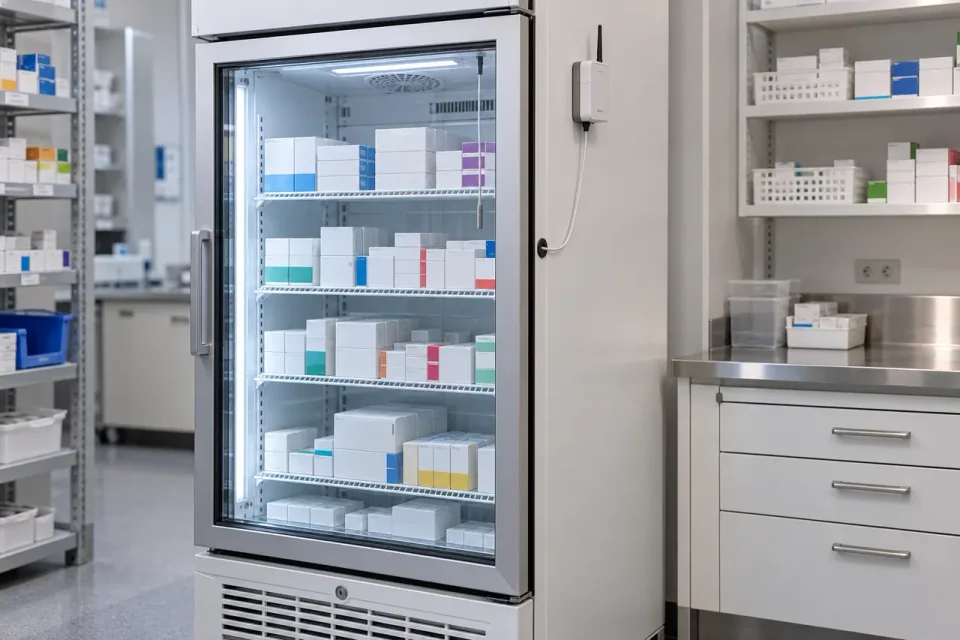
The sensor should suit the measurement range, operating conditions and required accuracy. Probe mounting, cable routing and the ability to replace a battery or service the unit without disrupting storage all matter. A sensor near the door may behave differently from one deeper inside the compartment. A single measurement point does not automatically represent every location in the appliance.
Probe position is agreed according to the fridge’s construction, storage arrangements and available documentation. If the process requires temperature distribution mapping, define it as a separate task. Calibration, sensor identification and the link between a certificate and a particular measurement point are agreed in the same way. Buying a device that displays readings does not replace these arrangements.
Separate measurement, transmission and alarm intervals
Several different timings exist within the system: the interval between measurements, data transmission frequency, alarm assessment delay and notification delivery time. Data refreshing on screen do not necessarily mean that a new measurement has just been taken. Historical records and the dashboard should therefore display the sample time, not just the time the user opened the page.
Recording too infrequently can make a short event difficult to assess. Overly aggressive alarm settings can generate numerous notifications during normal door opening. Parameters are selected for the process and the device’s capabilities. Acceptance should check how the system records a change, when it reports it and whether it also records the end of the event when conditions return to the agreed range.
Set thresholds, delays and hysteresis deliberately
The alarm threshold, the duration of an excursion and the threshold for returning to normal perform different functions. Hysteresis helps prevent repeated alarm transitions near a limit. A delay can reduce notifications from short changes caused by normal handling, but should not conceal events significant to the stored products. The person responsible for the process approves these decisions.
An alarm delay must be distinguished from a physical measurement buffer. A probe measuring within an agreed buffer may respond differently from a probe measuring air. Neither arrangement is automatically correct for every fridge. The documentation should record the method, settings and reasons for choosing them, so that subsequent users interpret the chart consistently.
Detect missing data and power dependencies
The absence of a new sample is not a normal temperature reading. The system should distinguish an out-of-range value from loss of contact with a sensor, a gateway fault or unavailable transmission. Displaying the last known number without showing its age can create a misleading sense of control. Plan a separate stale-data alert and a procedure for checking locally.
Establish what will work during a power or internet outage. Keeping only the gateway powered will not sustain a router supplied from another circuit. Equally, working communications do not mean the fridge is still powered. Monitoring, power to the appliance and power to communications each require separate assessment. If devices store samples locally, check how they are subsequently transmitted and time-stamped.
Plan escalation and responsibility after an alarm
For every type of alarm, identify the first recipient, their cover and the next step if no acknowledgement is received. A telephone number stored in the configuration does not prove that someone is on call. Arrangements must account for absence, staff changes, nights and non-working days. The recipient should recognise the equipment, location and acknowledgement method, rather than receiving only an unclear message containing a sensor number.
The technical response may include checking the power supply, doors, fridge operation and connectivity. Decisions on handling products after an excursion are made by authorised staff under the appropriate procedures. Neither the installer nor a chart replaces that assessment. DATPOL Healthcare can organise the measurement layer, historical records, notifications and agreed technical monitoring without taking over pharmaceutical decisions.
Accept the system through testing and clear records
Before considering deployment complete, check sensor identification, time accuracy, historical recording, access permissions and delivery of the agreed notifications. Tests of excursions and lost communication should be carried out safely for the products, at a designated test station or under an agreed procedure. Acceptance should also cover substitute recipients and users’ ability to recognise messages.
Establish who checks batteries, carries out inspections and updates alarm recipient lists. Records should make it possible to locate a particular device and time period, while reports should clearly identify data gaps. Revisit assumptions after replacing a fridge, moving a probe or changing the process. Settings agreed at initial installation should not remain unreviewed after significant changes to operating conditions.
A PRACTICAL FIRST STEP
What should you prepare for a discussion?
- Storage requirements approved by the responsible person.
- A list of fridges, measurement points and power sources.
- Agreed probe location, measurement method and documentation.
- Thresholds, delays, hysteresis and stale-data alerts.
- Recipients, cover arrangements and an out-of-hours escalation procedure.
- Acceptance tests, access to records and an ongoing support plan.
Questions before working together
Is a temperature reading in an app sufficient?
A reading does not replace historical records, assessment of data freshness or a response procedure. It is also necessary to know what happens when power or connectivity is lost.
Does DATPOL determine acceptable medicine storage temperatures?
Authorised staff determine product requirements using the relevant documentation. DATPOL selects and configures the agreed technical monitoring layer.
Are calibration and temperature mapping the same thing?
No. Calibration relates to the measuring characteristics of an instrument, while mapping examines the distribution of conditions within a space. The need for and scope of each are established for the particular process.
Does an alarm automatically trigger a service visit?
No. Notifications, on-call cover, response times and interventions follow the agreed service model. The responsibilities of pharmacy staff must be identified separately.