Integration of actuators with the safety strategy. Installing equipment is only part of the task: the whole system must also respond correctly.
Fire-isolation controls and fire closures within the building strategy
Fire-isolation controls and fire closures require a defined response within the relevant strategy. Their impact on other installations must be understood before changes are made, particularly in buildings with backup power and extensive technical infrastructure.
We review control documentation, the distribution of installations and the available signals. The work does not involve users independently choosing which equipment to disconnect. The required functions follow from the design and agreed arrangements.
What can the DATPOL Healthcare scope include?
Fire-isolation controls and interfaces with the power installation.
Fire closures and controls within the agreed scope.
Interfaces with fire alarms, smoke control and other building systems.
Functional tests, signal checks and documentation.
Interfaces with other systems
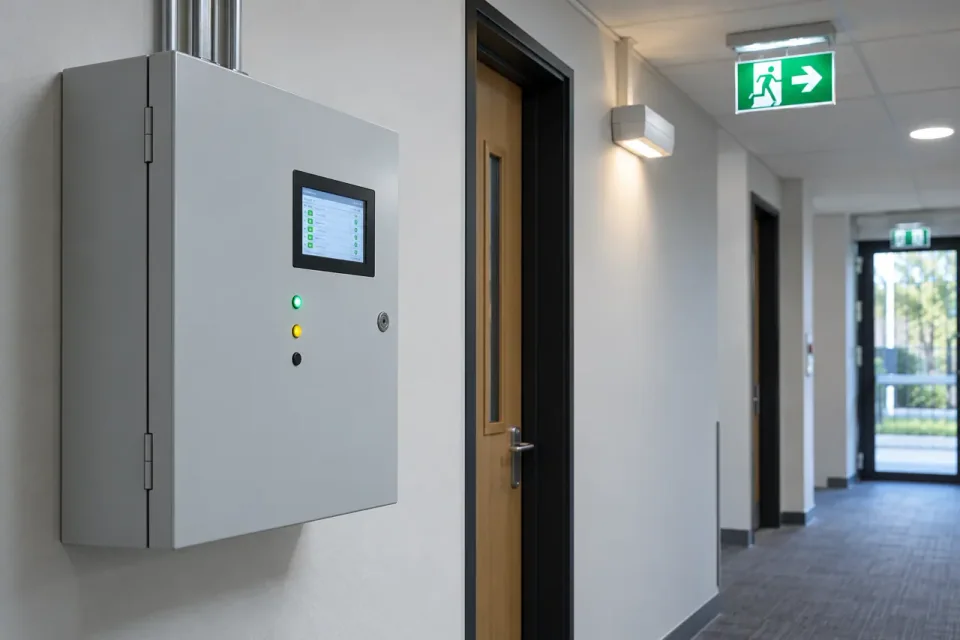
The available controls for fire closures, access control, fire alarms and smoke control must follow the agreed operating sequence. Convenience in everyday door use must be distinguished from fire safety functions.
We agree interfaces, power supplies, normal and fault states, and how responses will be confirmed. This reduces situations where each contractor checks only their own equipment and nobody tests the complete chain.
Testing after installation and changes
Checks cover the initiating element, the control system and the actual effect on the actuator. A signal on a visualisation screen alone does not confirm closure or achievement of the required state.
We document results and a list of findings. A change to configuration, equipment or use should prompt an assessment of whether interaction needs to be tested again.
Maintenance and a clear division of responsibility
The maintenance model defines who receives a fault report, who works on each system and who approves its return to operation. Temporary shutdown arrangements are agreed with the responsible people at the facility.
We organise documentation and the component register so that later work is not based on assumptions. This integration scope is part of DATPOL's existing fire safety expertise.
A PRACTICAL FIRST STEP
What should you prepare for a discussion?
- The facility type and location, and the people responsible for each area.
- Documentation for existing equipment and installations, where available.
- A description of problems, previous failures and the intended outcome.
- Access restrictions and permitted dates for work and testing.
- The existing maintenance scope and contacts for relevant suppliers.
- Planned changes to equipment or working arrangements.
Questions before working together
Where does defining the scope begin?
With an assessment of existing systems, documentation and the impact on the facility's work. We agree objectives, access, responsibility and acceptance criteria before selecting a solution.
Can only part of an existing system be upgraded?
Yes, where the installation's condition, documentation and equipment compatibility allow it. We first check limitations, phases and the conditions for carrying out the work safely.
Can the system be covered by a maintenance service after the work?
We agree inspections, monitoring and fault handling separately. Support hours, on-call cover and response times follow the contract, not merely the system's presence in a portal.
Related DATPOL service: Fire-isolation controls and fire compartmentation.