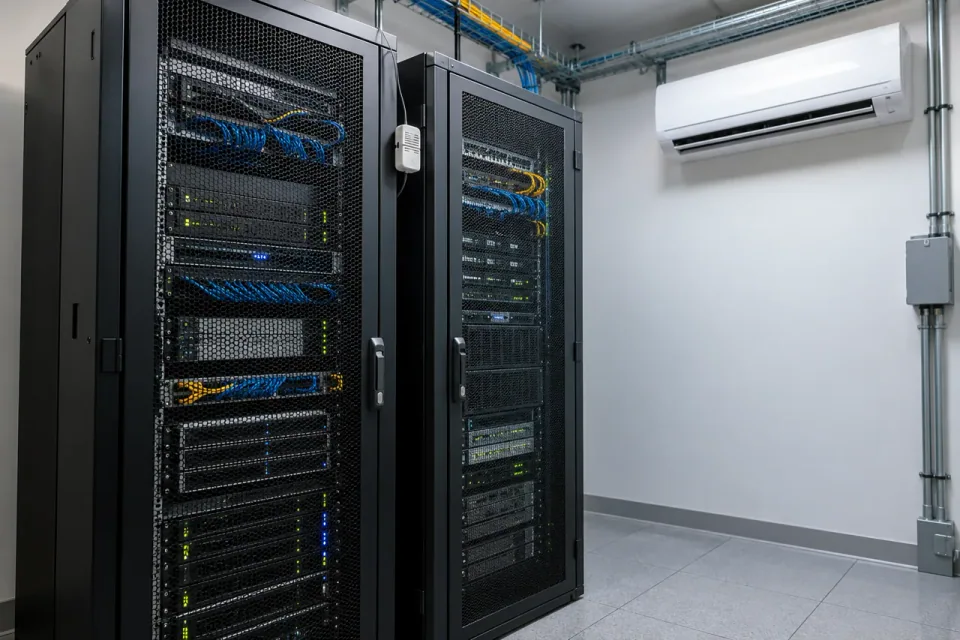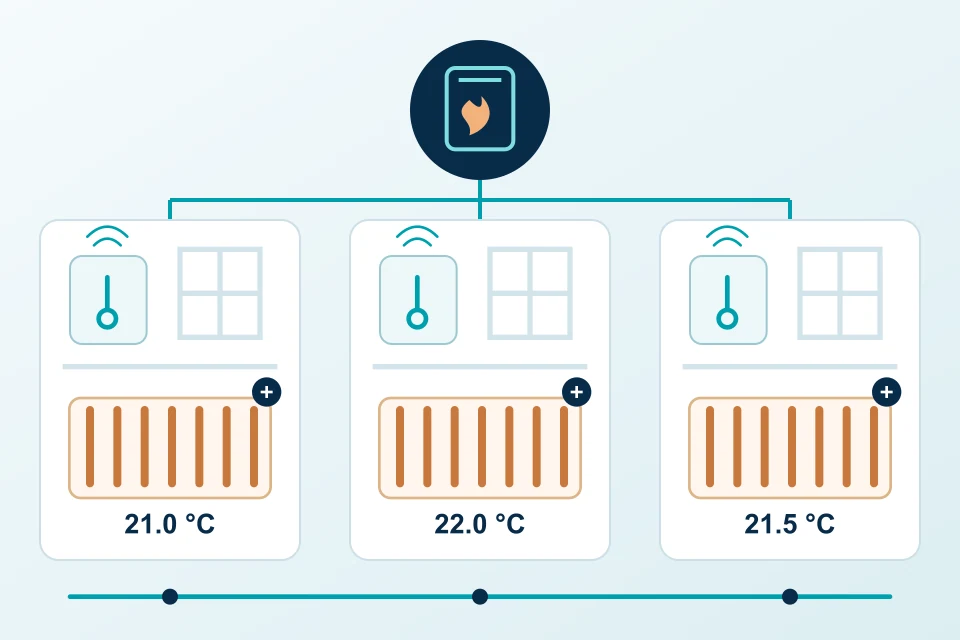
A single building-wide setting rarely suits every room. Residents’ rooms, wards, consulting rooms, reception and staff areas differ in occupancy, sunlight and heat availability. DATPOL Healthcare offers temperature comfort as an ongoing service: from surveying the installation and sensor network to zoning, monitoring and refining the operating strategy.
Room-by-room comfort requirements
We start with administration, staff and the technical manager. We define zones, room functions, occupancy hours and who may change settings. Residents’ rooms, consulting rooms, waiting areas and staff workspaces can follow different rules.
The result is a room schedule with agreed ranges, timetables and priorities. We also define when staff approval is needed and how to handle reports of overheating or insufficient heat. Controls should support the way care is delivered rather than impose one rigid pattern.
A sensor network measures actual conditions
Sensors are positioned to represent occupied spaces, accounting for windows, radiators, doors and sunlight. A reading at a radiator head can differ from conditions where people sit or rest. Where supported, we therefore use a separate room sensor as the control reference.
Wired or wireless connectivity is selected for the infrastructure, with coverage and maintenance access checked. Oversight includes reading freshness, communications and battery state where reported. A missing recent reading is a data issue, not evidence that the room temperature is correct.
FROM SENSOR TO INFORMATION
Equipment matched to the application
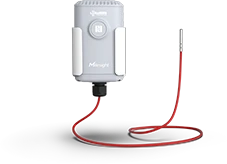
Sensor with a probe
Readings at an agreed point in a fridge or system.
Discuss selection →
Temperature and humidity
Room conditions and historical changes.
Discuss selection →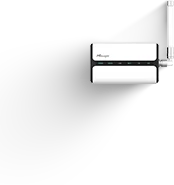
Communications gateway
Links compatible sensors to the monitoring system.
Discuss selection →Illustrative device types. Sensor selection, calibration, positioning and alarm thresholds must be agreed for the specific application.
Discuss equipment selection →Radiator, valve and heating-circuit control
The scope can include electronic radiator heads, valve actuators, underfloor manifolds, zone valves and integration with fan coils or air heaters. Actuators are selected for the valve, power supply and control interface. Identical equipment is not assumed for every room.
Several radiators in a room can follow a shared reading where the selected system supports it. We account for thermal inertia, setpoint limits and agreed manual adjustments. Acceptance checks the room’s actual response, not just whether a value changes on screen.
Integration with the existing heat source
Room regulation can be coordinated with a boiler, heat pump, district-heating interface, mixing circuit or another source providing a suitable control interface. Integration may use a heat-demand contact, manufacturer controller, supported protocol or BMS automation. Compatibility is checked for the actual equipment and installation.
Zone control does not replace source safety protections or sound hydraulic design. We agree how room demand relates to source operation, required flow conditions and the limits of control. Where necessary, work is coordinated with manufacturer service and the heating contractor.
Schedules, permissions and a staff view
Staff can have a simple view of their rooms: the current reading, agreed range and permission to adjust settings only within authorised limits. Administration can see the facility, history and service issues. Reading permission does not automatically grant control or configuration rights.
Schedules follow actual use rather than office hours alone. Temperature setbacks, open-window responses and other automation are agreed with the facility. In rooms occupied around the clock, the approved operating pattern remains the priority.
Predictable operation during faults
Before deployment we specify behaviour during internet loss, missing readings, low batteries and controller or actuator faults. We favour solutions with agreed local regulation and on-site operation. A valve’s fallback position or substitute setting depends on the design and actual device capabilities.
Acceptance includes sensor and actuator checks, communication loss, issue reporting and return to normal operation. Staff receive operating and escalation instructions. Availability of an online dashboard is not the sole measure of whether heating works correctly.
An ongoing comfort-maintenance service
After deployment we can provide agreed oversight: reading, battery and communication checks, investigation of deviations, seasonal reviews and schedule refinement. Changes in room use, replacement equipment and staff feedback are considered. History helps distinguish measurement, control and installation problems.
Responsibilities, response arrangements and the role of other service providers are agreed before handover. Outcomes are assessed against approved conditions and commissioning results. Opportunities to avoid unnecessary heating are checked using data; a fixed saving or identical performance in every building is not assumed.
A PRACTICAL FIRST STEP
What should you prepare for a discussion?
- A list of rooms, their uses and occupancy hours.
- Comfort needs and those authorised to approve setpoints.
- The heat source, radiators, valves and controllers.
- Installation records and the technical manager’s contact details.
- Available connectivity and restrictions on installation work.
- The required oversight, maintenance and staff-support scope.
Questions before working together
Can existing radiators be controlled?
Often yes, after checking valves, actuator fitting and installation condition. Radiator replacement is not always needed. Compatibility and the required work are confirmed during the survey.
Can the system work with any heat source?
Integration is designed for the existing boiler, heat pump, heating interface or other equipment. A suitable interface and compatible operation are required. Universal compatibility is not assumed without checking the equipment and installation.
Can each room have different settings?
Yes, where the installation supports independent zones. Ranges and permissions are agreed, followed by commissioning checks in the actual rooms.
What happens if internet access or a reading is lost?
Behaviour is specified and tested during commissioning. It can include local regulation, an agreed fallback setting and fault reporting, depending on the selected equipment.
Does this replace medicine-fridge monitoring?
No. Room comfort and medicine storage monitoring have different objectives and acceptance criteria. They can share a support arrangement, but are specified separately.
Related DATPOL service: DATPOL CARE — ongoing infrastructure support.