
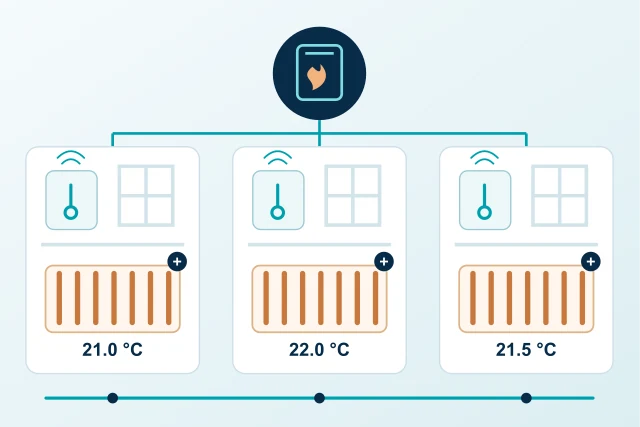
Begin with room requirements
For each zone, establish its function, occupied hours and who may change settings. Facility and process requirements take priority over generic comfort proposals. An online temperature range is not a universal requirement for consulting rooms, wards, stores and laboratories.
Record heat sources, circuit layout and existing controls. A radiator valve, circuit actuator, heat pump and air-handling unit need different integration methods. Equipment must support the intended control; switching its power supply is not a universally safe integration method.
Measurement must represent the zone
A sensor beside a radiator, window or heat source can misrepresent comfort. Choose its location for the room and validate it by comparing readings. The system should retain units, measurement time and availability. An old value must not be presented as current.
For battery-powered or wireless sensors, consider reporting frequency, coverage and battery maintenance. Room comfort monitoring and medicine-storage measurement are separate applications. They require their own sensor selection, records and response procedures.
Control, schedules and fault behaviour
Plan operation after server, sensor or network loss. Agree setting limits, manual overrides and their duration. Central control should verify commands where device feedback is available. Sending a command is not evidence of a temperature change.
Schedules include operating calendars and exceptions. Clock changes, restarts and restored connectivity should not trigger an uncontrolled backlog of commands. Temperature setbacks require facility approval. Percentage savings should not be promised without a baseline and an installation assessment.
Acceptance and maintenance
Acceptance covers reliable readings, an agreed setting change, actuator response and behaviour after communication failure. Check permissions: a person who can view a chart need not control a radiator. Staff receive a clear procedure for changing a setting and reporting a fault.
Maintenance checks missing data, battery condition, unsuccessful commands and recurring deviations. DATPOL Healthcare can integrate sensors and compatible controls with existing technical infrastructure, then agree ongoing support. Scope follows the actual capabilities of the facility’s equipment.
Questions before getting started
Does the entire heating system need replacement?
Not necessarily. Existing radiators, circuits and heat sources are assessed for integration first. Modernisation follows that assessment rather than an assumption that the whole installation must be replaced.
Discuss your scope with DATPOL
Tell us the type of facility, site count and the systems you want to review. Credentials and sensitive material are exchanged separately.
Discuss your requirements