Working lighting during a power failure and clear escape route signage form part of a building's readiness.
Escape routes must remain usable during a power failure
Emergency and escape lighting supports orientation and safe departure from designated areas. In a care or healthcare facility, the solution must match the actual layout of routes, rooms and equipment.
During the assessment, we review documentation, luminaire locations, signage, power sources and previous inspection findings. A new layout, doors or use of space may require an updated solution rather than simply replacing a luminaire with a similar model.
What can the DATPOL Healthcare scope include?
Selection, installation and upgrading of luminaires and signage.
Functional checks and agreed runtime tests.
Monitoring, maintenance and documented findings.
Coordination with power supplies and the requirements of each area.
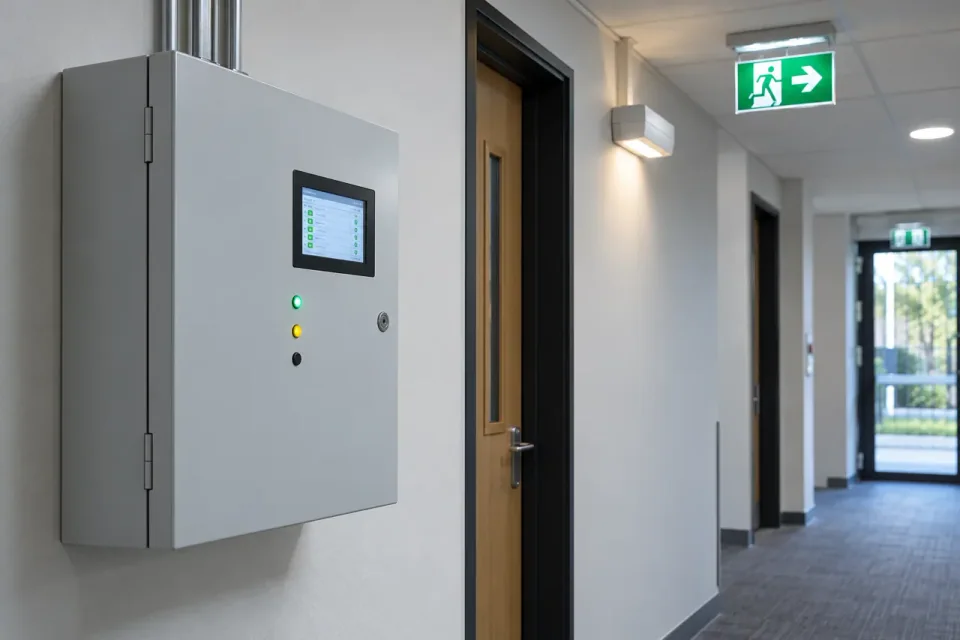
Selecting luminaires and testing arrangements
Performance, locations and required operating duration are established for each building. We select the solution with environmental conditions, operation and service access in mind. We do not specify one runtime as suitable for every facility.
Self-contained battery systems and centrally supplied solutions have different maintenance dependencies. Both require condition checks and a distinction between a functional test and a test of operation over the required duration.
Testing with clearly recorded results
Testing should identify which luminaire works, which reports a fault and where repair is needed. An equipment register, identifiers and work history help resolve problems without starting the search again at the next inspection.
The scope of testing and checks is agreed from the documentation. After an upgrade, current drawings, identifiers and confirmation that the correct circuits operate are important.
Lighting within a building maintenance model
Maintenance includes fault handling, battery and luminaire condition, and keeping the inspection schedule current. Integrating available signals helps organise monitoring, but does not replace a physical test.
We connect this area with power supplies and the maintenance plan for other installations. The facility then has one organised schedule of activities and a clearly defined point of contact.
A PRACTICAL FIRST STEP
What should you prepare for a discussion?
- The facility type and location, and the people responsible for each area.
- Documentation for existing equipment and installations, where available.
- A description of problems, previous failures and the intended outcome.
- Access restrictions and permitted dates for work and testing.
- The existing maintenance scope and contacts for relevant suppliers.
- Planned changes to equipment or working arrangements.
Questions before working together
Where does defining the scope begin?
With an assessment of existing systems, documentation and the impact on the facility's work. We agree objectives, access, responsibility and acceptance criteria before selecting a solution.
Can only part of an existing system be upgraded?
Yes, where the installation's condition, documentation and equipment compatibility allow it. We first check limitations, phases and the conditions for carrying out the work safely.
Can the system be covered by a maintenance service after the work?
We agree inspections, monitoring and fault handling separately. Support hours, on-call cover and response times follow the contract, not merely the system's presence in a portal.
Related DATPOL service: Emergency and escape lighting.